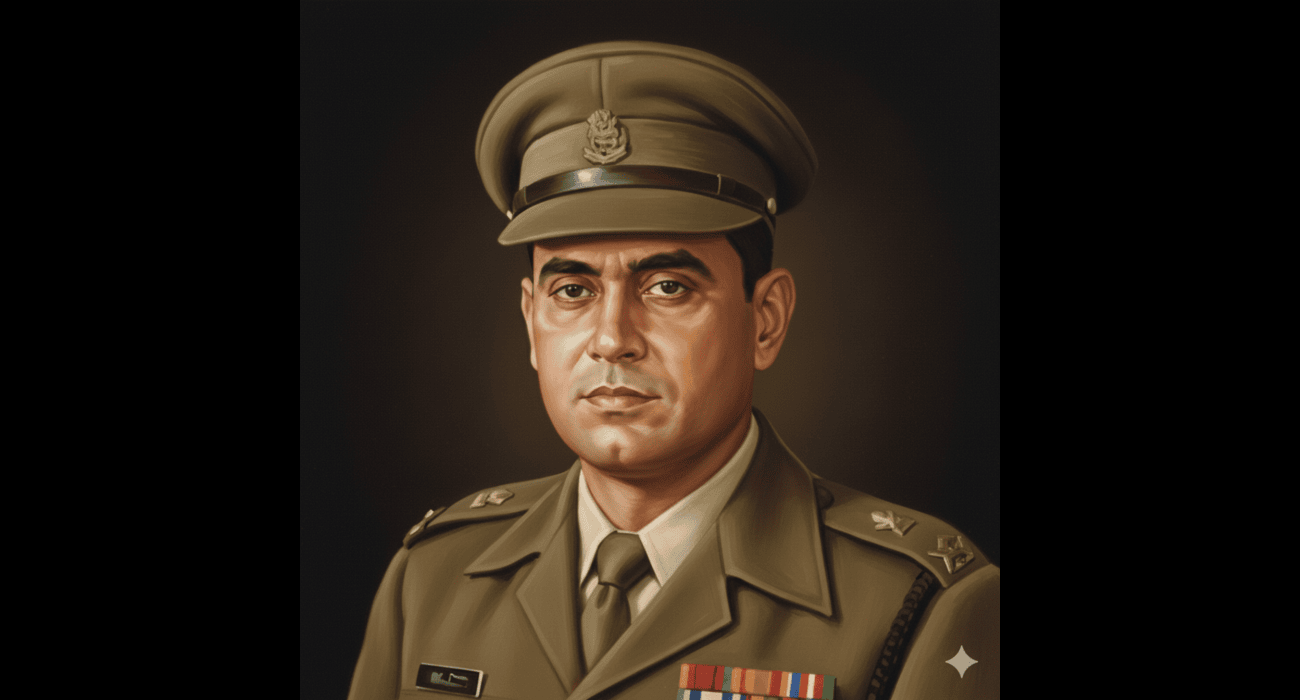
Introduction – A Legend in Indian Military History
In the annals of Indian military history, few names shine as brightly as Major Shaitan Singh, PVC. His story is not just one of extraordinary courage, but of unwavering leadership, sacrifice, and the indomitable spirit that defines the Indian soldier. Born into a family with deep military roots, Major Shaitan Singh became a symbol of bravery during the 1962 Sino-Indian War, particularly in the legendary Battle of Rezang La. His actions that day inspired generations and earned him India's highest military honor, the Param Vir Chakra (PVC), posthumously.
🏅 Quick Facts About Major Shaitan Singh
📅 Birth Date: 1 December 1924
📍 Birthplace: Banasar village, Jodhpur district, Rajasthan, India
⚔️ Military Unit: 13 Kumaon Regiment, Indian Army
🎖️ Highest Award: Param Vir Chakra (PVC) – India's highest military decoration
💀 Date of Martyrdom: 18 November 1962
📍 Place of Heroism: Rezang La, Chushul sector, Ladakh (17,000 feet altitude)
🏆 Key Achievement: Led 120 soldiers against overwhelming Chinese forces; refused evacuation despite mortal wounds
Early Life and Family Background – The Making of a Warrior
Major Shaitan Singh was born on 1 December 1924 in Banasar village, Jodhpur district, Rajasthan. He was the son of Lieutenant Colonel Hem Singh, a decorated officer in the Indian Army, which meant that Shaitan Singh grew up surrounded by stories of valor and discipline. His family's legacy of service to the nation shaped his early years and instilled in him a deep sense of duty and patriotism.
Coming from a military family, Shaitan Singh was no stranger to the rigors of army life. His upbringing in Rajasthan, a land known for its rich warrior heritage, warrior kingdoms, and historic forts, further fueled his desire to serve the country with distinction. The values of courage, honor, and sacrifice were not abstract concepts for young Shaitan Singh—they were lived experiences within his household.
His father's military career served as both inspiration and preparation. Growing up in such an environment, Shaitan Singh imbibed the military ethos from an early age, learning that true greatness comes not from personal glory, but from selfless service and willingness to sacrifice everything for the nation.
Military Career and Commission – Building a Soldier's Legacy
Shaitan Singh's formal entry into military service came when he joined the Indian Army and was commissioned as an officer on 1 August 1949. He was assigned to the 13 Kumaon Regiment, a unit renowned for its exceptional bravery, discipline, and resilience in challenging terrains and situations. This regiment would become synonymous with his name and legacy.
Over the years following his commission, Shaitan Singh proved himself to be a capable, dedicated, and principled officer. He earned the unwavering respect of his peers, superior officers, and subordinates alike through his leadership qualities, tactical acumen, and unwavering commitment to duty. Unlike officers who led from behind, Shaitan Singh was known for leading by example, always putting his soldiers' welfare above his own.
His early postings included strategic deployments in Ladakh, where he gained invaluable experience in high-altitude mountain warfare. He learned the intricacies of operating in extreme climates, managing logistics in isolated regions, and maintaining troop morale in some of the world's harshest environments. This experience would later prove absolutely crucial during the 1962 war, as he was well-versed in the unique challenges of high-altitude combat—thin air, extreme cold, limited supplies, and hostile terrain.

The 1962 Sino-Indian War – India's Military Crucible
The 1962 Sino-Indian War was a defining moment in independent India's history—a conflict that tested the nation's military capabilities, political resolve, and the courage of its soldiers. Though the war ultimately resulted in a ceasefire that many viewed as unfavorable to India, it produced countless stories of individual heroism that continue to inspire the nation.
It was during this war that Major Shaitan Singh's extraordinary courage and leadership qualities would be tested and ultimately immortalized. His actions at Rezang La would become the stuff of legend, inspiring generations of soldiers and civilians alike.
Deployment at Rezang La – A Lonely Outpost
Major Shaitan Singh was commanding Charlie Company of the 13 Kumaon Regiment, stationed at Rezang La in the Chushul sector of Ladakh. The location itself was strategically significant but tactically challenging—situated at an altitude of approximately 17,000 feet above sea level on a windswept pass in the Himalayan range.
The conditions at Rezang La were brutally harsh:
- Altitude Sickness: At 17,000 feet, the air contained roughly 40% less oxygen than at sea level, making every physical action exhausting
- Sub-Zero Temperatures: Temperatures plummeted to -20°C or lower, with howling winds that could reach 80+ km/h
- Limited Resources: The outpost was isolated, with supplies arriving infrequently; soldiers often made do with inadequate winter clothing
- Strategic Vulnerability: The company was exposed on a pass with limited defensive positions and no easy escape routes
- Operational Challenges: Communication with higher command was difficult; rapid reinforcement was impossible
Despite these harsh conditions, Major Shaitan Singh and his 120 men—many of them young soldiers experiencing combat for the first time—maintained their defensive positions and kept morale high. They knew that their role was crucial to India's defensive strategy in the region.
The Chinese Assault – Battle Begins
On 18 November 1962, the Chinese People's Volunteer Army (PVA) launched a massive, coordinated assault on Rezang La. What began as a military engagement quickly became an epic struggle for survival and honor.
The Chinese forces attacked in successive waves with overwhelming numerical superiority:
- Force Ratio: Major Shaitan Singh's 120 soldiers faced an estimated 1,500–2,000 Chinese troops
- Firepower Disparity: The Chinese possessed superior weapons, including mortars, machine guns, and heavy artillery
- Wave Attacks: Instead of a single assault, the Chinese attacked in successive waves, trying to overwhelm the Indian positions through attrition
- Environmental Advantage: The Chinese soldiers were also affected by altitude, but their superior numbers meant they could absorb casualties
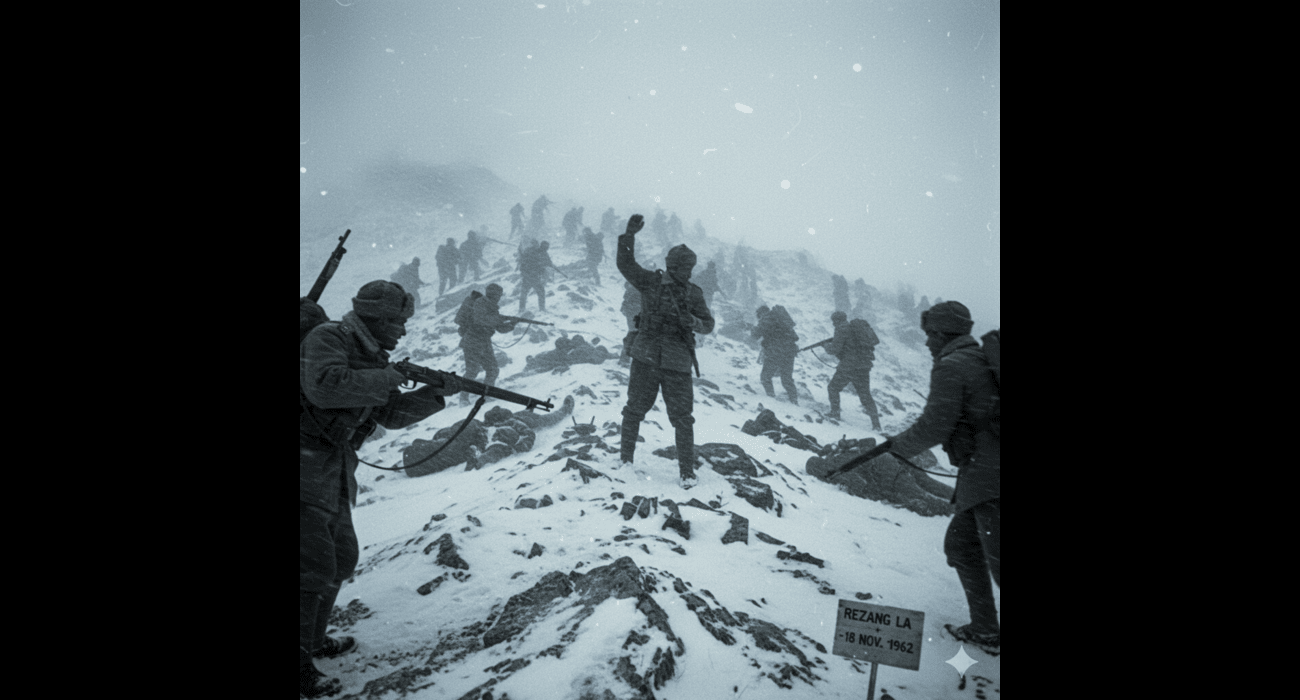
The Indian company held firm. Though outnumbered more than 10:1 and facing an enemy with superior firepower, the soldiers under Major Shaitan Singh's command fought with determination and discipline. They repelled wave after wave of Chinese attacks, inflicting heavy casualties on the enemy.
Leadership and Sacrifice – The Heart of a Warrior
Throughout the brutal battle, Major Shaitan Singh displayed exceptional leadership qualities that defined his character. Despite being heavily outnumbered, despite the freezing cold and thin air, despite knowing the odds were impossible, he never faltered.
His remarkable actions included:
- Constant Movement: He moved from one platoon post to another, often exposing himself to enemy fire to boost morale
- Personal Bravery: He was at the forefront of the defense, encouraging his men through personal example and direct participation
- Strategic Direction: Despite the chaos of battle, he maintained overall tactical control and directed troop movements
- Casualty Care: He ensured that wounded soldiers received whatever medical attention was possible in those desperate circumstances
- Unwavering Resolve: He maintained absolute confidence in victory, refusing to allow despair to take hold
During the ferocious fighting, Major Shaitan Singh was grievously wounded in both arms and the abdomen. The injuries were severe—the kind that would normally force immediate evacuation. But Shaitan Singh refused to be evacuated. When his men insisted on carrying him to safety, he ordered them to leave him behind.
His reasoning was clear and profoundly human: every soldier needed in the fight was precious. His evacuation would require multiple men to carry him and protect him, men who were desperately needed in the trenches. So he remained, continuing to direct his troops and encourage his men, even as his life ebbed away from his wounds.
The Human Cost – Sacrifice and Valor
The battle raged throughout the day and into the night. Major Shaitan Singh's Charlie Company fought with unmatched courage and determination:
| Aspect | Details |
|---|---|
| Total Company Strength | 120 soldiers |
| Indian Casualties | 114 soldiers killed (95% casualty rate) |
| Major Shaitan Singh's Status | Killed in action (died from wounds received in battle) |
| Enemy Casualties (Estimated) | Over 1,300 Chinese soldiers killed or wounded |
| Duration of Battle | Approximately 24–48 hours of intense fighting |
| Strategic Result | Chinese forces did not break through the pass; delayed enemy advance significantly |
The casualty figures are staggering. Out of 120 soldiers, 114 were killed—a 95% casualty rate. Yet, for every Indian soldier lost, the Chinese paid an even heavier price. The 13 Kumaon Regiment's Charlie Company under Major Shaitan Singh inflicted an estimated 1,300+ casualties on the Chinese forces, an extraordinary achievement for a defending company that was vastly outnumbered.
This disparity in casualty ratios is the most eloquent testimony to Major Shaitan Singh's leadership and his soldiers' courage. They did not just die passively; they fought with tactical brilliance and personal valor, making every position count, every shot count, every life count.
Param Vir Chakra – India's Highest Military Honor
For his extraordinary bravery, exceptional leadership, and supreme devotion to duty during the Battle of Rezang La, Major Shaitan Singh was awarded the Param Vir Chakra (PVC), India's highest military decoration, posthumously.
The Param Vir Chakra is awarded to members of the armed forces who display conspicuous bravery in the face of the enemy. It is given for acts of exceptional valor and sacrifice. The fact that Major Shaitan Singh received this highest honor reflects the extraordinary nature of his actions and the profound impact his leadership had on the battle and on Indian military history.
The Official Citation
The official citation for his Param Vir Chakra reads:
Recognition and Official Notification
His name was officially notified in the Gazette of India on 26 January 1963—Republic Day, symbolically honoring his sacrifice as a contribution to the Republic's security and sovereignty. The timing was deliberate and significant, marking him as a national hero whose legacy belongs to all Indians.
The Param Vir Chakra awardees form an elite group—as of today, only around 21 have been awarded this honor since independence. Major Shaitan Singh stands among this rare pantheon of exceptional warriors and leaders.
Legacy and Cultural Impact – Living in Memory
Major Shaitan Singh's story did not end with his martyrdom in 1962. Instead, it has only grown in significance and resonance with each passing year. His legacy manifests in multiple dimensions:
Military Heritage and Training
The 13 Kumaon Regiment continues to honor Major Shaitan Singh's memory as a role model for officer training and leadership development. His tactical decisions during the battle are studied in military academies and officer training institutions. His principle of leading from the front and putting soldiers' welfare above one's own continues to be emphasized in military ethics training.
Rezang La War Memorial
The Rezang La War Memorial stands as a permanent tribute to Major Shaitan Singh and the 120 brave soldiers of Charlie Company. Located at the actual battle site in Ladakh, the memorial has become a place of pilgrimage for soldiers, civilians, and patriots. Prime Minister Narendra Modi inaugurated the revamped memorial in November 2021, underscoring the national importance placed on honoring this sacrifice.
Popular Culture and Cinema
Major Shaitan Singh's story has inspired filmmakers and storytellers. Most notably, the film "120 Bahadur" (120 Heroes), directed by and starring Farhan Akhtar, is based on the events of the Battle of Rezang La and Major Shaitan Singh's leadership. The film brought his story to a new generation, ensuring that his sacrifice and valor are never forgotten.
Beyond this specific film, numerous documentaries, television productions, and historical accounts have featured Major Shaitan Singh, keeping his memory alive in popular consciousness.
Educational Significance
Major Shaitan Singh's biography is taught in schools and colleges across India as part of history and civics curricula. His story teaches lessons about courage, leadership, sacrifice, and patriotism that go far beyond military contexts. It's a story about human excellence under impossible circumstances.
Personal Character and Leadership Philosophy
Beyond the battlefield heroics, Major Shaitan Singh was known for his distinct personal character and leadership philosophy:
Humility and Modesty
Despite his officer rank and ability, Major Shaitan Singh was known for his humility. He didn't seek glory or recognition; he simply did his duty. This humility made him beloved by his men, who saw in him not an aloof superior but a fellow soldier willing to share their hardships.
Compassion and Care for Soldiers
He was renowned for his deep concern for the welfare of his troops. He ensured they had adequate provisions, proper uniforms, and medical attention. During the harsh conditions at Rezang La, he shared in the suffering of his men rather than claiming privileges of rank.
Leading by Example
Major Shaitan Singh embodied the principle of leading by example. He was always at the front, facing dangers that his men faced. His soldiers knew that he would never ask them to do anything he wasn't willing to do himself.
Unshakeable Resolve
What struck everyone about Major Shaitan Singh was his unshakeable resolve. Even when facing certain death, he remained calm, focused, and committed to his mission. This steadfastness inspired his men to maintain their own courage and determination.
Sense of Duty
Above all, Major Shaitan Singh had an profound sense of duty. His duty to his country, to his regiment, and to his individual soldiers. This sense of duty transcended personal fear, pain, and even mortality. It was this duty that motivated his refusal to be evacuated—his soldiers needed him, and duty came first.
The Battle in Historical Context – Strategic Significance
While Major Shaitan Singh's personal heroism is extraordinary, it's important to understand the strategic context of the Battle of Rezang La:
Defensive Importance
Rezang La controlled a strategic pass in the Ladakh region. Its loss would have allowed Chinese forces to advance more easily into the Chushul Valley and potentially threaten key Indian positions. By holding Rezang La for as long as possible, Major Shaitan Singh's company bought precious time for Indian forces to organize defenses elsewhere.
Delaying Action
Though ultimately the Chinese forces did push through Rezang La, the heavy toll they paid significantly delayed their advance. Military historians argue that this delay was crucial in forcing the Chinese to agree to a ceasefire before they could advance further into Indian territory.
Morale and National Pride
In a war where India faced significant military reversals, the brave stand at Rezang La provided a psychological boost. It demonstrated that Indian soldiers could stand toe-to-toe with their opponents despite numerical disadvantages. This had immense significance for national morale.
The Battle in Historical Context – Strategic SignificanceWhile Major Shaitan Singh's personal heroism is extraordinary, it's important to understand the strategic context of the Battle of Rezang La:
Defensive Importance
Rezang La controlled a strategic pass in the Ladakh region. Its loss would have allowed Chinese forces to advance more easily into the Chushul Valley and potentially threaten key Indian positions. By holding Rezang La for as long as possible, Major Shaitan Singh's company bought precious time for Indian forces to organize defenses elsewhere.
Delaying Action
Though ultimately the Chinese forces did push through Rezang La, the heavy toll they paid significantly delayed their advance. Military historians argue that this delay was crucial in forcing the Chinese to agree to a ceasefire before they could advance further into Indian territory.
Morale and National Pride
In a war where India faced significant military reversals, the brave stand at Rezang La provided a psychological boost. It demonstrated that Indian soldiers could stand toe-to-toe with their opponents despite numerical disadvantages. This had immense significance for national morale.
Comparison with Other PVC Awardees – Standing Among Giants
To understand the magnitude of Major Shaitan Singh's achievement, it's useful to compare his actions with other Param Vir Chakra awardees:
| Soldier/Officer | Rank | War/Conflict | Notable Achievement |
|---|---|---|---|
| Major Shaitan Singh | Major | 1962 Sino-Indian War | Led 120 soldiers against 1,500+ Chinese troops; refused evacuation despite mortal wounds |
| Sepoy Ram Kumar Singh | Sepoy | 1965 Indo-Pakistani War | Single-handedly captured multiple enemy positions despite injuries |
| Naib Subedar Yogendra Singh Yadav | Naib Subedar | 1999 Kargil War | Youngest PVC awardee; captured strategic mountain positions |
| Lance Naik Albert Ekka | Lance Naik | 1971 Indo-Pakistani War | Died while protecting his soldiers from enemy fire |
Frequently Asked Questions About Major Shaitan Singh
1. Who was Major Shaitan Singh?
Major Shaitan Singh was an officer of the 13 Kumaon Regiment, Indian Army, who became legendary for his exceptional courage and leadership during the Battle of Rezang La on 18 November 1962, during the Sino-Indian War. He was awarded the Param Vir Chakra, India's highest military decoration, posthumously.
2. When and where was Major Shaitan Singh born?
Major Shaitan Singh was born on 1 December 1924 in Banasar village, Jodhpur district, Rajasthan, India. He came from a military family—his father, Lieutenant Colonel Hem Singh, was a decorated officer in the Indian Army.
3. What was Major Shaitan Singh's military unit?
Major Shaitan Singh served in the 13 Kumaon Regiment of the Indian Army. He commanded Charlie Company of this regiment during the Battle of Rezang La. The regiment continues to honor his memory and legacy.
4. When did Major Shaitan Singh join the Indian Army?
Major Shaitan Singh was commissioned as an officer in the Indian Army on 1 August 1949. He had prior military experience and training before his commission.
5. What was the Battle of Rezang La?
The Battle of Rezang La was fought on 18 November 1962 during the Sino-Indian War. Major Shaitan Singh's Charlie Company of 120 soldiers faced an estimated 1,500–2,000 Chinese troops at Rezang La, a strategic pass at 17,000 feet in Ladakh. Despite overwhelming odds, the Indian soldiers inflicted heavy casualties on the enemy before being overrun. 114 of the 120 Indian soldiers were killed.
6. Why is the Battle of Rezang La significant?
The battle is significant for multiple reasons: (1) It demonstrated exceptional Indian military valor despite overwhelming odds; (2) The heavy Chinese casualties delayed their advance, forcing them to agree to a ceasefire; (3) It inspired generations of Indian soldiers and civilians; (4) It resulted in one of the highest casualty ratios (killed enemy soldiers to Indian soldiers) in modern military history.
7. What was Major Shaitan Singh's role in the battle?
Major Shaitan Singh was the commander of Charlie Company. He led the defense against successive waves of Chinese attacks, moved among his troops to boost morale, fought from the front, and continued directing operations even after receiving mortal wounds. He refused evacuation, insisting that every able-bodied soldier was needed in the fight.
8. How many soldiers died at Rezang La?
114 out of 120 Indian soldiers were killed in the battle, resulting in a 95% casualty rate. All 114 soldiers died while fighting to defend their position. The survivors were those who were away from the main battle site or managed to escape before being completely surrounded.
9. What was the Param Vir Chakra?
The Param Vir Chakra (PVC) is India's highest military decoration for bravery and valor in the face of the enemy. It is awarded for exceptional courage and sacrifice. Only about 21 soldiers have received this honor since Indian independence, making it one of the world's rarest military decorations.
10. When did Major Shaitan Singh receive the Param Vir Chakra?
Major Shaitan Singh was awarded the Param Vir Chakra posthumously. His name was officially notified in the Gazette of India on 26 January 1963 (Republic Day). The posthumous award recognized his extraordinary heroism during the battle.
11. Did Major Shaitan Singh survive the battle?
No, Major Shaitan Singh was killed in action during the Battle of Rezang La on 18 November 1962. He died from wounds received during the intense combat. He refused evacuation despite his mortal injuries, choosing to remain with his soldiers until the end.
12. Is there a memorial for Major Shaitan Singh?
Yes, the Rezang La War Memorial stands at the battle site in Ladakh and honors Major Shaitan Singh and the 120 brave soldiers of Charlie Company. The memorial was renovated and inaugurated by Prime Minister Narendra Modi in November 2021. It has become a place of pilgrimage and historical significance.
13. What films or documentaries have been made about Major Shaitan Singh?
The most notable film based on Major Shaitan Singh's story is "120 Bahadur," directed by and starring Farhan Akhtar. The film dramatizes the Battle of Rezang La and Major Shaitan Singh's extraordinary leadership. Multiple documentaries have also featured his life and achievements.
14. What was the casualty ratio at Rezang La?
The casualty ratio was extraordinarily favorable to the Indian forces relative to their numbers. While 114 Indian soldiers were killed, the Chinese suffered an estimated 1,300+ casualties (killed and wounded). This means approximately 11–12 Chinese soldiers were killed or wounded for every Indian soldier lost, an exceptional achievement for an outnumbered defensive force.
15. How is Major Shaitan Singh remembered today?
Major Shaitan Singh is remembered as one of India's greatest military heroes. He is taught in schools and colleges as an exemplar of courage, leadership, and sacrifice. The 13 Kumaon Regiment honors his memory in officer training. The Rezang La War Memorial stands as a permanent tribute. His story continues to inspire new generations of Indians.
Lessons from Major Shaitan Singh's Life – What We Can Learn
1. Leadership in Impossible Circumstances
Major Shaitan Singh demonstrated that true leadership is most clearly visible when circumstances are impossible. Any commander can lead when resources are abundant and odds are favorable. But it takes extraordinary character to maintain focus, courage, and unit cohesion when facing certain defeat. His ability to lead his men effectively despite overwhelming disadvantages offers lessons applicable far beyond military contexts.
2. Putting Others Before Self
His refusal of evacuation—choosing to stay with his men despite mortal wounds—encapsulates a profound principle: true leadership means sacrificing personal welfare for the welfare of those under your care. This principle transcends military life and applies to leadership in all contexts.
3. Courage as Choice, Not Absence of Fear
Major Shaitan Singh wasn't fearless; he was courageous. There's a crucial difference. Courage is the choice to do what's right despite fear. His calm and strategic thinking despite the terror of battle show that courage is a conscious choice, a moral decision to overcome natural fear.
4. The Power of Personal Example
His soldiers fought with extraordinary determination because their commander was at the front, sharing their dangers. He inspired through action, not just words. This demonstrates the power of leading by example.
5. Duty Over Personal Preference
Major Shaitan Singh understood that he had a duty—to his country, his regiment, his soldiers. This sense of duty was his compass when making impossible decisions. In modern life, where personal preference often dominates decision-making, his unwavering commitment to duty offers an alternative model.
6. Resilience Under Pressure
The ability to maintain strategic clarity and tactical composure while under intense attack and suffering mortal wounds shows extraordinary mental resilience. This quality—the ability to think clearly and act decisively under extreme stress—is invaluable in any leadership role.
Major Shaitan Singh's Legacy in Modern India
Military Academia and Training
Major Shaitan Singh's battles, tactics, and leadership decisions are studied in military academies worldwide. His case is used to teach leadership principles, tactical decision-making under pressure, and the psychology of combat.
National Consciousness
His story has become part of India's national consciousness. He represents the best qualities that Indians aspire to—courage, sacrifice, duty, and unwavering commitment to principles. Schools across India teach his story to young students as an example of what true patriotism means.
Inspiration for Armed Forces
Every soldier in the Indian Army knows Major Shaitan Singh's name. He represents the highest ideals of military service. Young officers joining the army are told his story; his example sets the standard for what is expected.
Cultural Symbol
Beyond military contexts, Major Shaitan Singh has become a cultural symbol of Indian resilience and bravery. His image appears on commemorative stamps, in museums, in films, and in literature. He represents a certain ideal of the Indian character.
The Rezang La War Memorial – Honoring the 120 Heroes
Location and Access
The Rezang La War Memorial is located at the actual battle site in Ladakh, near Chushul, at approximately 17,000 feet altitude. It's one of the highest war memorials in the world. The memorial is accessible by road, though the high altitude and remote location present challenges.
Structure and Design
The memorial features:
- A central structure bearing the names of all 120 soldiers who fought and died
- A statue of Major Shaitan Singh, standing prominently
- Black granite plaques with detailed information about the battle
- A museum and interpretation center detailing the history of the battle
- Prayer areas for visitors of various faiths
Visiting the Memorial
The memorial has become an important pilgrimage site for soldiers, veterans, and civilians. Many visitors report profound emotional experiences at the site. The extreme altitude and harsh environment add to the solemnity of the place—you feel the sacrifice more deeply when standing where it occurred.
Prime Minister Modi's 2021 Visit
Prime Minister Narendra Modi's inauguration of the renovated memorial in November 2021 underscored the national importance placed on honoring this sacrifice. The event brought widespread media attention and reinforced the story in national consciousness.
Conclusion – A Life Lived for Something Greater
Major Shaitan Singh, PVC, represents something increasingly rare in the modern world: a life lived for something greater than personal advancement or comfort. His story is a reminder that true greatness comes not from seeking recognition, but from devotion to duty and willingness to sacrifice everything for principles and people you care about.
From his early years in Rajasthan to his final stand at Rezang La, Major Shaitan Singh's life was a journey of courage, leadership, and sacrifice. His refusal to be evacuated despite mortal wounds, his continued direction of troops while bleeding out, his unwavering commitment to his soldiers' welfare—these actions define what it means to be a true leader.
The Battle of Rezang La might have been lost in military terms, but Major Shaitan Singh and his 120 soldiers won something far more valuable: immortality. Their names will be remembered as long as India exists. They sacrificed their lives so that others could live in freedom and security.
Major Shaitan Singh's legacy is not about individual glory or personal achievement. It's about what ordinary people can accomplish when they dedicate themselves completely to a cause greater than themselves. In a world often obsessed with personal branding and individual recognition, his example of selfless service stands as a powerful counterpoint.
Every Indian owes a debt of gratitude to Major Shaitan Singh and the brave soldiers under his command. They gave everything—their youth, their futures, their very lives—for the nation. The least we can do is remember them, honor them, and ensure that their sacrifice is never forgotten.
🇮🇳 Jai Hind. Jai Major Shaitan Singh. Jai to all the brave soldiers of Rezang La.
