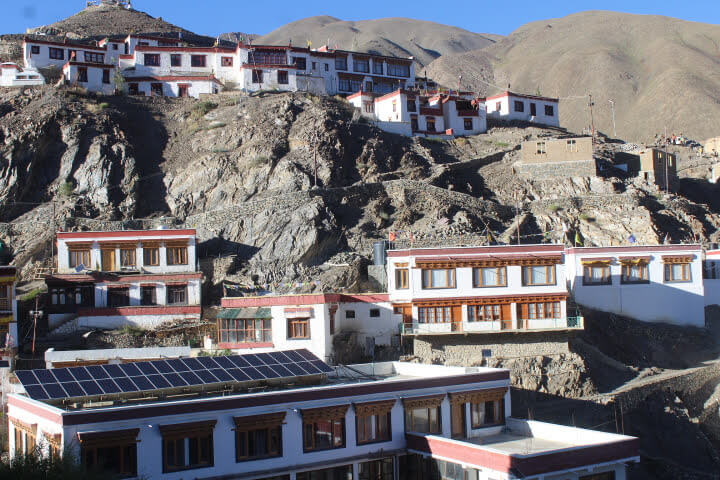
Lamayuru Monastery, often simply called Lamayuru, is one of the oldest and most revered Buddhist monasteries in Ladakh, India. Perched on a steep ridge between Bodhkarbu and Kha-la-che, it is also known by the local name Tharpa Ling, which means the “place of freedom.” Its mystical surroundings—including barren hills and lunar-like terrains—often earn it the nickname Moonland of Ladakh.
History & Legends of Lamayuru Monastery
- Legend says the valley where Lamayuru stands was once a lake inhabited by naga (serpent deities). The Bodhisattva Madhyantika prophesied that a monastery would someday stand here.
- Mahasiddha Naropa (10th–11th century) meditated here and caused the lake to recede. On the exposed bed, he found a dead lion and built the first temple, Singhe Ghang (Lion Mound).
- In 1038 CE, translator Rinchen Zangpo built five temples at Lamayuru, part of his effort to construct 108 monasteries in the Western Himalayas.
- Over centuries, Lamayuru underwent many restorations. Today, only the central structure stands intact, while remnants of the others remain visible.
Religious Affiliation & Monastic Life
- Currently affiliated with the Drikung Kagyu school of Tibetan Buddhism.
- Earlier one of the foremost Bon monasteries, with the name linked to the Bon symbol Yungdrung (swastika, representing eternity).
- At its peak, Lamayuru housed up to 400 monks; currently around 150 permanent monks reside here.
Architecture & Highlights
- Main Dukhang (Assembly Hall) richly decorated with murals and paintings.
- Naropa’s cave, part of the shrine area, where Naropa meditated.
- Mural-covered entrance verandah depicting Guardians of the Four Directions and monastic life scenes.
- Houses thangkas, murals, scriptures, and statues of Buddhist deities like Avalokitesvara.
- Tiered complex blends with rugged terrain, giving an organic feel.

Location & How to Reach
- About 115 km west of Leh city, Ladakh, at an elevation of ~3,510 meters (11,520 ft).
- Accessible via Leh–Srinagar Highway (NH-1 / NH-1D route).
- Most travelers visit on a day trip from Leh; nearby guesthouses are available for overnight stays.
Things to See & Do
- Walk the monastery courtyard and halls to admire murals and iconography.
- Visit Naropa’s cave and experience its spiritual ambiance.
- Explore the moonland landscapes for photography opportunities.
- Attend the Yuru Kabgyat festival (two-day masked dance festival, typically in June) if visiting during the right season.
- Engage with monks, attend prayers if allowed, and soak in the calm spirituality.
Lamayuru Monastery Photos & Visuals
Photography is generally allowed in external areas. The vibrant walls against lunar-like landscapes make for stunning visuals.
Best Time to Visit
- Summer (May to September) is the peak season; roads are open, and skies are clear.
- Festivals like Yuru Kabgyat fall in summer, adding cultural richness.
- Winter visits are difficult due to snow and road closures.


